
★★★★1/2
Sonia Smith for Arts Muse Magazine
Ahmad Alameldeen’s extraordinary animated short transforms 12 years of humanitarian frontline experience into a deeply affecting cinematic statement about humanity, survival and the innocent lives caught in conflict.
Some films entertain. Others challenge, provoke and demand that audiences confront realities they might otherwise choose not to see. SAFE ZONE, the Oscar-qualified animated short from writer-director Ahmad Alameldeen, belongs firmly in the latter category.
At a time when images of war, displacement and humanitarian suffering dominate international headlines, SAFE ZONE delivers a powerful and urgently relevant message: hunger is not simply an unfortunate consequence of conflict. When access to food, clean water and medicine is deliberately denied, it becomes a weapon, and innocent civilians pay the ultimate price.
What makes this film particularly compelling is the extraordinary experience behind its creation. Alameldeen is not approaching the subject as an outsider. Before turning to filmmaking, he spent 12 years working on the humanitarian frontline, witnessing the realities of war and human suffering across Iraq, Syria, Libya, Somalia, Nigeria, Tunisia, Liberia and Laos. His work with organisations including the United Nations, the International Committee of the Red Cross and Médecins Sans Frontières placed him in environments where the consequences of conflict were not statistics or newspaper headlines, but human beings fighting to survive.
That experience gives SAFE ZONE an authenticity and emotional urgency that distinguishes it from more conventional animated storytelling.
Rather than identifying a particular country, government or conflict, Alameldeen makes the inspired creative decision to tell a universal story. The civilians depicted could belong to any number of communities around the world. Their suffering transcends nationality, religion and geography. In doing so, the filmmaker ensures that audiences cannot comfortably dismiss the events as somebody else’s tragedy.
This is a film about humanity, and what happens when humanity is abandoned.
One of SAFE ZONE’s greatest strengths is its decision to use animation to explore such devastating subject matter. Animation has long demonstrated its ability to communicate difficult emotional truths, but here the medium feels particularly appropriate. It creates a visual language through which audiences can confront the horrors of starvation, fear and desperation without reducing those experiences to sensationalised imagery.
The film’s artistic approach is also fascinating in the context of one of the most controversial conversations currently taking place within the entertainment industry: the role of artificial intelligence in filmmaking.
Rather than relying on AI to generate its creative foundations, Alameldeen and his team began with original hand-drawn characters and artwork. Individual compositions were carefully developed before AI technology was used to introduce movement. The result is an approach that places human artistic expression at the centre of the filmmaking process, with technology functioning as a tool rather than replacing the creative vision.
There is something particularly significant about that decision. In a film concerned with the preservation of human dignity, the human hand remains essential to the images themselves.
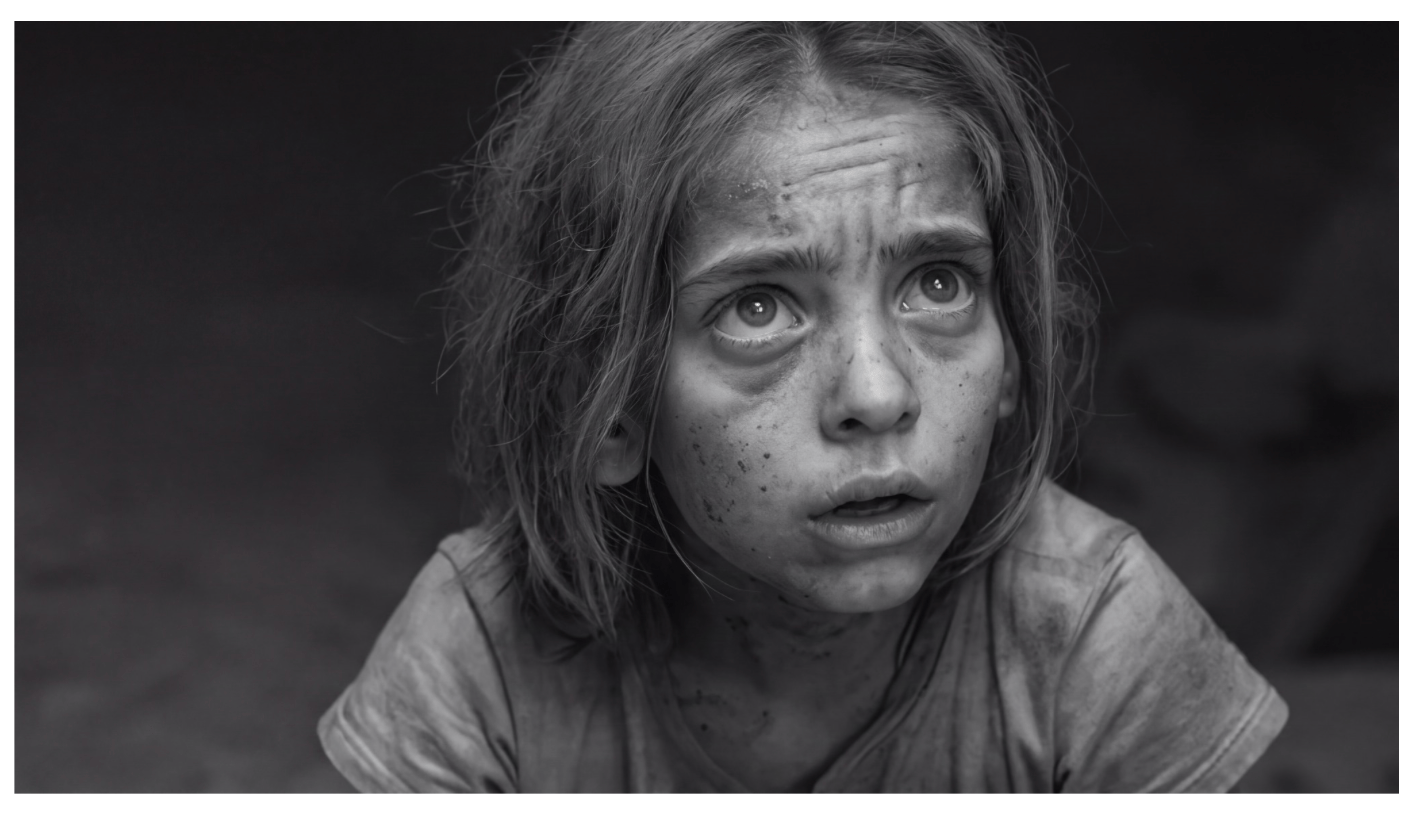
Indeed, the filmmakers reportedly encountered technological limitations when attempting to portray people experiencing extreme distress, particularly children. Those challenges reinforce an important distinction between artificial intelligence and human understanding. Technology may be capable of creating movement, but capturing the emotional complexity of suffering requires something far more profound.
The film’s emotional power comes not from the technology used to animate it, but from the human experiences that inspired it.
Perhaps the most unsettling aspect of SAFE ZONE is its central subject: the deliberate deprivation of life’s most basic necessities. Hunger is rarely given the same cinematic attention as explosions, gunfire or the immediate violence of battle, yet its consequences can be equally devastating.
Alameldeen recognises that the absence of food, medicine and humanitarian assistance can become a form of violence in itself. The film invites audiences to consider the terrifying vulnerability of families who have nowhere to escape, no means of protecting their children and no certainty that help will arrive.
It is an important reminder that behind every humanitarian emergency are ordinary people whose lives have been transformed by circumstances beyond their control.
There is also a striking moral clarity to the film’s approach. SAFE ZONE does not require audiences to understand the complicated political histories behind individual conflicts. Instead, it asks a much more fundamental question: How can the suffering of innocent civilians ever be considered an acceptable instrument of war?
That question gives the film its relevance and its emotional force.
The Academy Awards have increasingly recognised animated shorts that move beyond traditional expectations of the medium, embracing filmmakers who use animation to explore memory, trauma, identity and social injustice. SAFE ZONE belongs within that conversation, presenting animation not simply as an artistic form but as a vehicle for humanitarian storytelling.
Its Oscar qualification is particularly meaningful because the film represents an unusual meeting of two worlds: frontline humanitarian experience and cinematic expression. Alameldeen has spent years witnessing the consequences of international crises, and he is now using that knowledge to create stories capable of reaching audiences far beyond the humanitarian sector.
The short also originated from a larger live-action feature screenplay, with the animated version initially developed as a proof of concept. Yet SAFE ZONE has a clear purpose as a standalone work, introducing themes that could support a much broader cinematic exploration.
For a filmmaker making the transition from humanitarian work into narrative cinema, it is an ambitious and deeply personal choice of subject.
What makes SAFE ZONE so important during awards season is not simply the seriousness of its subject matter, but the perspective Alameldeen brings to it. Many filmmakers research humanitarian crises. Far fewer have spent more than a decade working directly among the communities affected by them.
That distinction matters.
His experiences offer a foundation for storytelling rooted in encounters with the people whose suffering the world so often overlooks. Rather than allowing those individuals to disappear into the anonymity of international news coverage, SAFE ZONE seeks to restore their humanity.
And perhaps that is the film’s most important achievement: encouraging audiences to see beyond the language of conflict, borders and military strategy, and recognise the human lives at stake.
Could SAFE ZONE become a serious contender in the Academy’s Best Animated Short Film race? Its combination of urgent subject matter, an unconventional production process and a filmmaker with firsthand humanitarian experience certainly gives it a distinctive identity in the awards conversation.
At its heart, however, SAFE ZONE is about something far more important than awards recognition.
It is about children who should never have to experience starvation. Parents who should never have to choose between impossible alternatives. Families who deserve access to food, clean water, medicine and safety, regardless of where they were born or which conflict surrounds them.
In an increasingly divided world, Ahmad Alameldeen has created a film with a message that should unite us all.
Hunger should never be a weapon. Humanity should never be negotiable. And the innocent should never be forgotten.
SAFE ZONE is an urgent, thought-provoking and deeply necessary contribution to contemporary animated cinema, and a film whose message deserves to be heard far beyond the Academy Awards.

