

By Roman Neeson
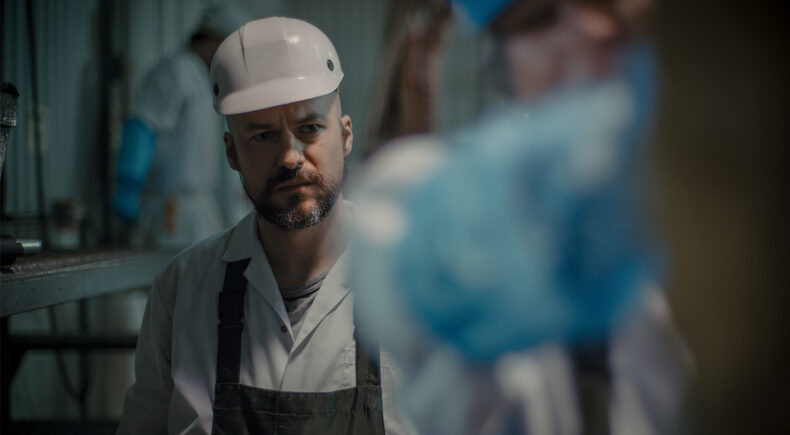
Pier-Philippe Chevigny’s Mercenaire is quickly becoming one of the most electrifying titles shaping the 2025 awards conversation. Now officially qualified for the Academy Awards® in the Best Live Action Short Film category, the film marks a defining moment for the Quebec filmmaker whose career has been steadily gathering force. Known for his fierce blend of suspense, political urgency, and visceral realism, Chevigny has already proven his singular voice with his debut feature Richelieu, which garnered international acclaim at Karlovy Vary, Tribeca, and Palm Springs. With Mercenaire, he sharpens that voice into something even more explosive, leaner, bolder, and unflinchingly humane.
After premiering at TIFF, Mercenaire surged through the global festival circuit, earning more than seventy-four selections and thirteen major awards, including the prestigious Special Jury Award at Clermont-Ferrand, a distinction that often signals an Oscar-season heavyweight. As the film heads toward its worldwide VoD release on Rover on November 15th, it carries the momentum of a project both critically embraced and culturally urgent. Its distributor, h264, already behind three Academy Award–nominated shorts, adds further weight to its campaign, positioning Mercenaire as a potent contender in one of the most competitive categories.
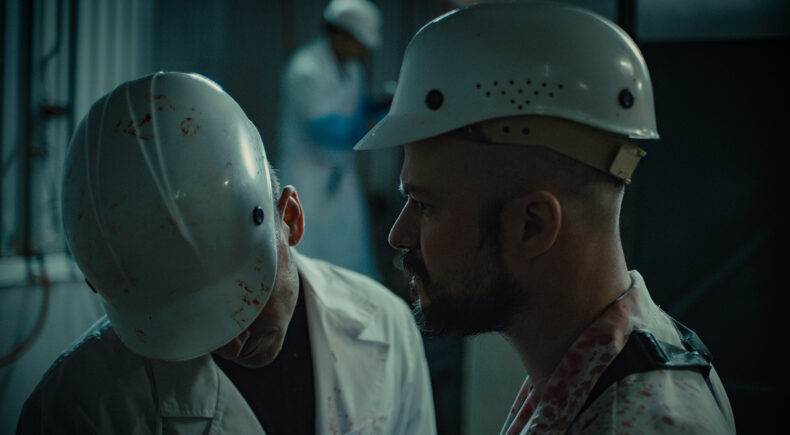
At the center of the film is Marc-André Grondin, whose performance anchors the narrative with a striking, internalized power. Known for his roles in C.R.A.Z.Y. and The Ravenous, Grondin embodies David, a recently released ex-inmate navigating the fragile terrain of reintegration. Through a social reinsertion program, he is assigned to work on a pig slaughterhouse line, one of the few industries in Quebec that routinely recruits ex-prisoners, funneling them from one system of violence directly into another. The cruelty of the industrial kill floor, compounded by mounting aggression from his co-workers, forces David into a harrowing moral standoff with himself. In a place where life is extinguished with mechanical regularity, the line between survival and relapse grows dangerously thin.
Chevigny’s filmmaking is at its most immersive here. Serving as writer, director, and editor, he constructs a sensory world defined by dread and claustrophobia, drawing the audience into the grind of metal, machinery, and confinement. Simran Dewan’s cinematography carves out an industrial harshness that feels both hyperreal and mythic, while Suzel D. Smith’s production design and Simon Gervais’ soundscape deepen the oppressive rhythm of the slaughter line. Every element works to situate viewers inside David’s experience, where the noise is relentless, the air itself feels heavy, and the threat of emotional and physical rupture hovers over every shift.
In Mercenaire, Chevigny extends his ongoing exploration of social fractures, particularly the contradictions embedded in Quebec’s labour structures. Though the justice system claims rehabilitation as its mission, many men like David find themselves pushed back into environments that reinforce the very violence they are trying to leave behind. “I wanted the audience to experience the noise, the fear, the anxiety,” Chevigny has said, “to feel how difficult it is to break the cycle when society only sees you as a threat.” That emotional volatility, rendered with cutting precision, is what elevates Mercenaire beyond social critique and into something deeply cinematic.
Produced by Geneviève Gosselin-G. of Le Foyer Films, the short expands Chevigny’s body of work into terrain that is both intimate and ethically provocative. It is a film unafraid to confront the realities of factory farming, not as a distant political issue but as a system intertwined with human lives pushed to society’s margins. The result is a story that lingers long after its final frame, haunting, urgent, and undeniably alive.
As awards season builds, Mercenaire stands as one of the year’s most arresting contenders, a film that seizes its moment not through spectacle but through the quiet, devastating force of its convictions.
 Arts Muse Magazine