
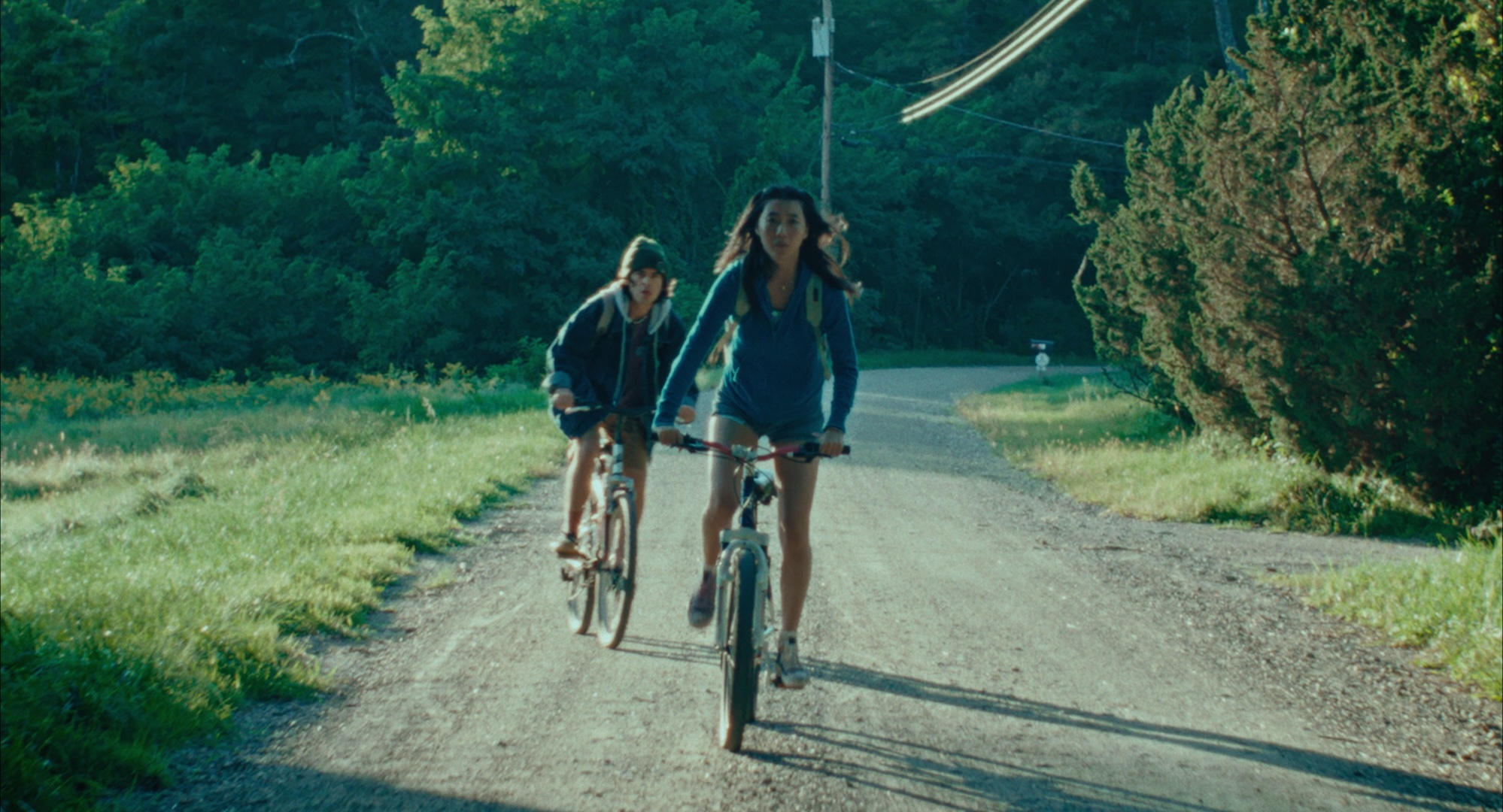
With The Truck, her Oscar-qualified, Telluride-premiering, Grand Jury Prize–winning debut short, writer and director Liz Rao has swiftly positioned herself as one of the most vital new voices redefining American independent cinema. Set in a single pressure-cooker of a morning in post-Roe America, the film follows a Chinese American teenager and her boyfriend as they attempt to buy the morning-after pill in a small Southern town where reproductive rights are heavily policed, both explicitly and quietly. Rather than stage political arguments or lean on melodrama, Rao frames the story through lived emotional detail, small, uncomfortable, painfully real moments that reveal how national headlines transform into intimate, personal stakes.

Rao began writing the film in the immediate aftermath of the Roe reversal. “When Roe was overturned, it was such an emotional moment for so many people in America,” she says. “I started talking with my friends and imagining what it is like to grow up as a teenager today. I felt in my gut how pressing it is to share one young woman’s experiences in a way that brings to life the daily realities of what these sweeping changes mean for people living under these shifting laws.” The urgency of the moment shaped the film’s emotional tone, but Rao was equally committed to a sense of intimacy, finding a balance between the political landscape and the quieter story unfolding between two young people trying to navigate their future.
That balance is also rooted in her own lived experiences. Rao grew up between Tennessee and Chicago, and her memories of both places, full of charm, contradictions, and complexities, infuse the film’s perspective. “I was lucky to have a pretty idyllic childhood growing up in Tennessee and Chicago,” she says. “Near my childhood home, just outside of Nashville, it is all winding country roads, Southern hospitality, and lush, at times wild farmland. That landscape is always in my heart. At the same time, as the daughter of immigrants from Southern China, you are always reminded that there is another side of the beauty of this place that is not at all romantic, nor welcoming. That duality for me is the state of the American dream as we see it playing out now.” It is this duality, beauty and threat, nostalgia and unease, that shapes The Truck’satmosphere.

Visually, Rao and cinematographer Gianna Badiali leaned into that tension. “We originally wanted to shoot on 16mm film to evoke nostalgia and that mythical Americana,” Rao explains. “We could not afford it, and instead filmed on Alexa 16 mode as a nod to the look of 16mm. I wanted to lull and seduce, in a way, the audience into the romance of small-town America, before complicating that experience with the more harsh realities of our current moment.” The result is a picture that feels suspended between memory and modern anxiety, warm, grain-like textures overlaying a steadily building sense of dread.
This dread is amplified during the film’s centerpiece, an extended scene inside the truck from which the film takes its name. Rao decided early on to capture it through long, unbroken takes. “We filmed the main truck scene in very long unbroken takes,” she explains. “I gave the actors different objectives and elements to explore each time. Shirley Chen, Daniel Zolghadri, and Garrett Richmond are such fascinating and smart actors, so when we put them together, they formed this dynamic that was constantly shifting and so layered. Each one of them kept the other two on their toes at all times.” These takes allow the actors’ emotional rhythms, their hesitations, flashes of confusion, and small attempts at tenderness, to unfold authentically without interruption.
Sound design plays an equally critical role. “Movie silence is not silence at all!” Rao says with a laugh. “There are so many subtle background layers, for instance interrupted by a dog’s bark or the barely audible roll of thunder. In the truck scene in particular, we brought in a slowly building low frequency that is hardly audible when it crescendos, but accumulates in an almost subconscious way.” Working with sound designer Rotem Dror, she uses sound not just as background but as an emotional pulse that deepens the film’s atmosphere of quiet danger.
Much of Rao’s command of performance and rhythm comes from her background as both a producer and an editor. Early in her New York life, she produced experimental theater rehearsals for Josephine Decker, drawing from improvisation and performance techniques that shaped Madeline’s Madeline. “I love stepping into the actors’ space as a director, to create an uplifting space of exploration,” she says. “My writing and directing style is naturally geared toward building a vehicle and a world for the actors to play.” In parallel, she was learning verité documentary editing from Lynn True and Nelson Walker III while helping to finish Albert Maysles’s final film, In Transit. “I still draw on their radical humanism, patience, and keen ability to find the universal in idiosyncratic gestures and humorous details,” she says.
Festival audiences have responded deeply to this blend of intimacy and political immediacy. Rao says she has been genuinely moved by the personal stories viewers have shared with her after screenings. “I have been incredibly touched by all the audience members, some even in high school, who have shared their personal stories with me after seeing The Truck,” she says. “Every time someone opens up about something they may not have talked about before, it is such a beautiful and cherished experience for me.”
As she expands this world into her debut feature, Rao is looking to broaden its emotional range rather than simply deepen its darkness. “There are so many new realities to dread and to fear since I wrote The Truck,” she says. “I am excited to expand the humor and light in my feature film. Not to erase the darkness and the challenges and the sharp critique, but also to uplift the characters that give us all a sort of guiding light.” With her growing slate of accolades, her distinctive voice, and her unwavering commitment to exploring the most complex corners of modern American life, Liz Rao is emerging as one of the most compelling filmmakers of her generation, and The Truck is only the beginning.
 Arts Muse Magazine