
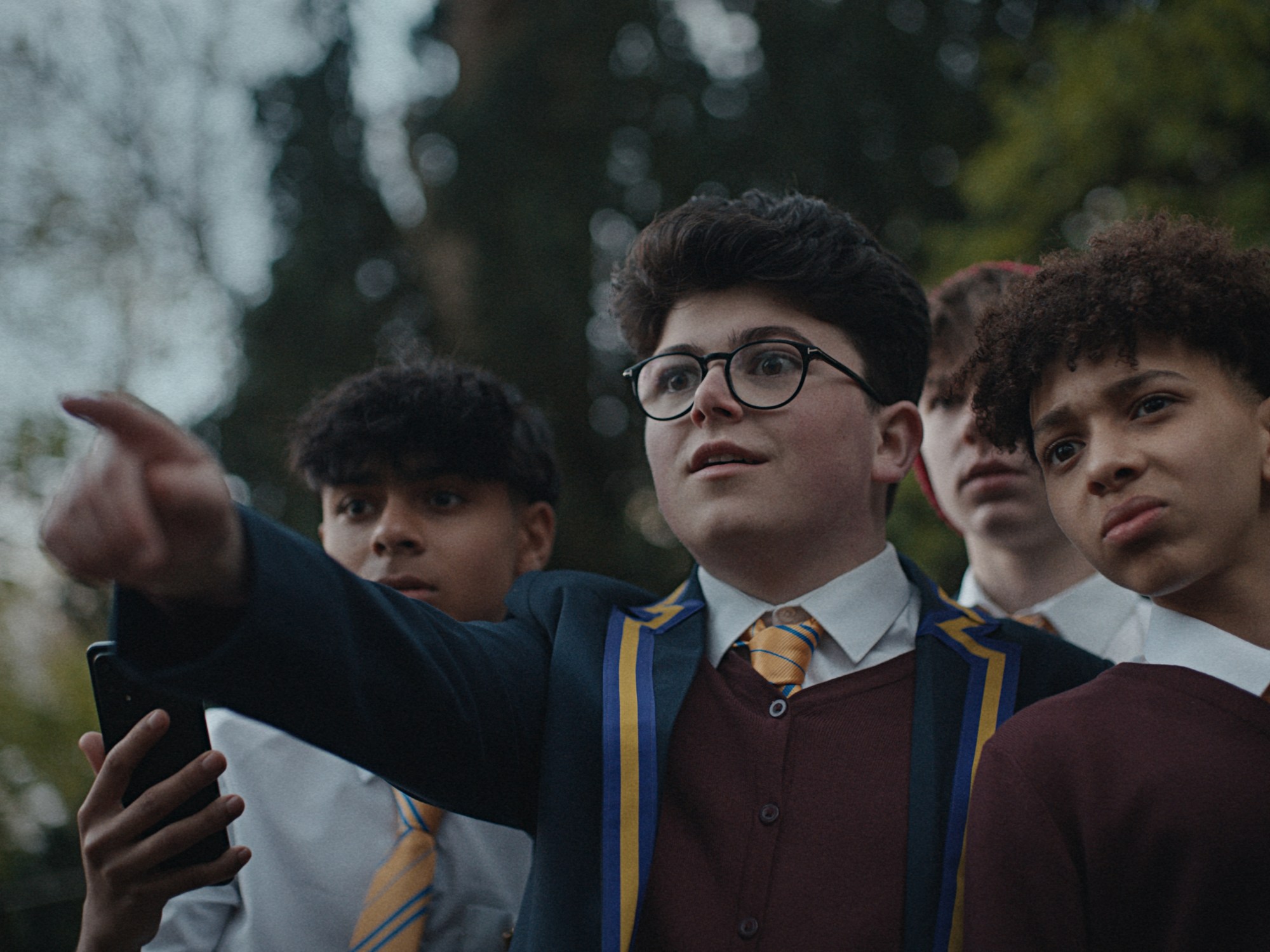
We sat down with CLOUT director Jordan Murphy-Doige to ask him a few questions about his new movie CLOUT.


INTERVIEW:
1. CLOUT blends psychological suspense with social commentary. What inspired you to tell this story through the lens of digital fame and adolescence?
It’s fascinating how our need for validation has evolved in the digital age, particularly among young people. The line between identity and performance is becoming increasingly blurred. The innocence of youth is, sadly, being robbed by big tech algorithms – playground politics no longer stay at school; they follow them home and into every waking moment.
We felt that a fable is always a strong foundation for storytelling, and The Boy Who Cried Wolf struck me as a perfect metaphor for social media – the highlights reel versus reality.
With CLOUT, we wanted to explore what happens when that pursuit of recognition – something we all crave to some degree – spirals into something darker and more sinister. Setting it within adolescence felt natural, because it’s such a formative period when you’re constantly trying to define who you are and where you fit in.
2. Were there specific films or filmmakers that influenced the tone or visual language of CLOUT?
Definitely. We drew a lot from Stand By Me – that nostalgic coming-of-age story perfectly captures youthful innocence and moral awakening. Its premise of four boys seeking a dead body to get their picture in the local paper was a direct nod for us – in CLOUT, it’s to go viral.
The Secret History was another inspiration for its psychological tension and moral ambiguity, while Black Mirror and Eighth Grade helped shape the balance between realism and unease. I looked to Shane Meadows and Lynne Ramsay for their ability to capture such honest and vulnerable characters. The goal was to create a world that felt heightened yet recognisably ours.
3. How did you balance the psychological thriller elements with the very real emotional arcs of your characters?
The thriller elements were always there to serve the emotional truth of the story. I never wanted it to feel sensationalised or detached from reality – the tension had to feel earned through character. Archie Yates, who plays Oskar, grounded the whole piece with such honesty that we could explore darker psychological territory without losing empathy for him.
4. How did you approach the theme of internet culture without making it feel preachy or overdone?
That was crucial for us. I wasn’t interested in making a film that wagged its finger at social media – that’s too easy, and it misses the nuance. The internet isn’t inherently bad; it simply amplifies human behaviour. So rather than judging it, we focused on showing a very human story playing out within that ecosystem. The commentary becomes more powerful when it feels lived-in rather than imposed.
Once we had cast the boys, Tom and I observed their behaviour and language to inform the dialogue and action. It was important that we captured their culture, not our preconceived notions of young people’s.
5. What challenges did you face in visually representing the tension between digital obsession and real-world consequences?
The biggest challenge was finding ways to externalise Oskar’s internal world. We planted breadcrumbs throughout, foreshadowing his ultimate demise. Collette Creary-Myers, our production designer, and I spent a lot of time weaving subtle visual nods into the narrative arc – water was ever-present, and the colour palette reflected the story’s foreboding tone.
Amelia Hazelrigg, our DP, and I spent long hours researching, sharing films and references to visually represent the narrative beats. We took a conceptual approach to Oskar’s metaphysical world and his sad demise – his ghost appears in the film, hidden in plain sight. We also used top-down camera shots as if he were watching his final day on earth, highlighting the voyeurism of today’s internet culture.
 Arts Muse Magazine